Carlos on fire

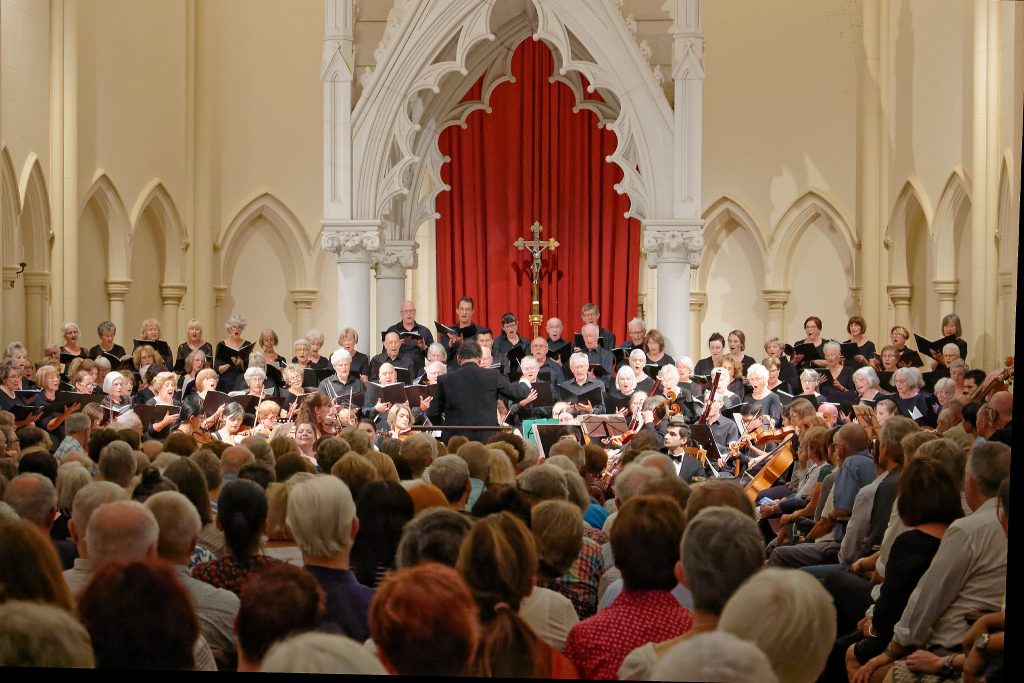
We nearly had to call the Fire Service to attend last night’s rehearsal.  Carlos was on fire.  What he had been doing for the rest of the day I do not know.  But by the evening he was well and truly ignited, fired with a passion for the music we are singing and fired by the vision of the performance he wants us to give in a few weeks’ time.

And when Carlos is on fire, he lights up all and sundry around him.  Nobody was spared.  All voices were put through the mill; our pitch, rhythm and intonation thoroughly assessed and, wherever necessary, corrected.

Never content with just notes, Carlos instilled in us the sense of the music; where to sing gently, and where to sing with strength; how to add colour and texture to reflect the conjunction of music and words; all the time projecting the true character of the music as if there were an audience somewhere in that crowded room.

By the end of the evening, our performance of those two key sections of The King Shall Rejoice was cemented in our musical consciousness.

I reflected as I drove home, with Thou hast prevented him and Allelujah still rushing around in my mind, that it’s at times like this that we should be very thankful to have such a great man as Carlos as our conductor.  It cannot be said too many times: we are extremely privileged to work with a consummate musician who not only understands all the intricacies of the music but also is ready to freely share his own innate musicianship with us.

We can look forward to a few more rehearsals in the same vein, as Carlos refines and polishes the rest of the music for the concert.

And we can look forward to two fabulous performances.  With a little more effort, we should sell all the tickets and sing to two capacity audiences, who will no doubt be thrilled with what they hear.


Thank you, SSO

As I sat down at the computer to start composing this week’s blog, I did not have an idea what to write about.  It is one of those days when the mind is blank – not that it should be, as we have done a fair few things this week, all of them memorable and interesting in their own way.

For example, Sculpture by the Sea was an enjoyable walk over the cliffs in sunny but not too warm weather, followed by a delicious lunch with stunning views over Coogee beach.

Then the Con Choir and Orchestra played a wonderful programme last weekend, including Mozart’s Great C Minor Mass, before which Ryan O’Donnell sang On Wenlock Edge by Vaughan Williams, evoking fond memories of a beautiful part of England which I used to cycle around in my teens.

So, bereft of ideas, I wandered into YouTube, to check out the links of the carols from last week’s blog, and, suddenly, something happened.  One of those infuriating adverts came up, interrupting the mental flow.  My initial temptation, as always, was to switch it off as soon as possible, but the strains of Wagner’s Ride of the Valkyries were so arresting that I stuck with it.  It was delightful!

It is an ad for the 2018 Season of the Sydney Symphony.  It is very imaginative, very creative and has a few surprises in store.  Click here to watch it – it only lasts just over a minute – less time than it takes to sing Omnes generationes from Bach’s Magnificat.  It would be intriguing to see what the panelists on Gruen might make of its appeal to all sorts and conditions of people.

So – many thanks to the SSO for giving me something to write about this week.  I do hope you enjoy watching the ad as much as I did.

PS.  Quite a number of our members are rehearsing this weekend for a performance of Verdi’s Requiem next weekend at Sydney Town Hall.  It is a huge work, extremely demanding but immensely satisfying to sing.  Good luck to them and their fellow choristers.   If you can, do go to the performance next Sunday afternoon – details on our NoticeBoard page.


The woods and the trees

As we got to grips with David Willcocks’ delightful arrangement of Lord of the Dance last night, I was struck by how difficult it is for choir and conductor alike.

Much of the rehearsal process consists of taking many different and apparently unrelated snippets of music quite out of context, polishing them in isolation, and only after much individual effort putting them all together to create a piece of music.  While we are rehearsing the individual segments, it is hard to see how they will all fit to make a coherent piece of music.  You could say that it is hard to see the wood for the trees.

I have found that listening to the music beforehand can help.  It’s true that it can be a bit like reading travel guides, which make much more sense after the visit than before.  But they do help to give the overall feel of a place, and some hints as to how to navigate your way around.  Similarly, listening to the music beforehand gives clues as to the role and place of your particular “snippets” in the piece, so that you can visualize the whole while practicing.

John Kibby’s excellent CD’s and Dropbox material make a wonderful foundation for our rehearsal preparation.  Here also are top quality performances on YouTube of the three carols from the Carols for Choirs book.  Just click on the links below – they only take a few minutes each, and you will find the time amply repaid at rehearsal next week when we sing them!

Lord of the Dance               The Jesus Child              The Shepherds’ Pipe Carol

Do you remember the Buzz Wire?

When I was a lad growing up in England, every Village Fete, Church Fair and School Fundraiser would have a row of pocket-money priced sideshows.  For a penny or two you could show off your skill and win a modest prize – a free lolly perhaps or a cheap trinket.  Of course they were quite challenging as the object of the exercise was to raise funds rather than to hand out prizes!

The Buzz Wire was a twisted piece of rigid wire.  The ends were about half a metre apart, but the wire, with all its twists and turns, was at least a metre long.  The wire was threaded through a metal loop about 2cm in diameter, which in turn was attached to a handle.  The challenge was to traverse the length of the rigid wire with the hoop, held in just one hand, without hoop and wire touching.  If they touched, then an electrical circuit would sound a buzzer or a bell, and your turn would be over.

I was thinking about the Buzz Wire last night as we were rehearsing the ups and downs and twists and turns of Bach’s choral writing in the Magnificat.  The shape of the wire is not unlike that of some of the phrases we have to sing – think of the theme in Fecit potentiam, for example.

We basses get off quite lightly, but Bach clearly had supreme confidence in his other voices, as the vocal contortions he asks of them are amazing.  Some of the twists are gentle, just a few notes apart and in a memorable sequence.  Then comes something quite different such as an octave jump up, then a smaller leap down, then more twiddly bits around the same or different sets of notes.

With the Buzz Wire, you have to keep the centre of the loop as close to the rigid wire as possible.  With singing Bach, we have to keep each note as close to the proper pitch as possible.  With the Buzz Wire, contact brings the buzzer or bell and the end of the turn.  With Bach it is the opposite. If we do not get just one note sufficiently close, Carlos’ internal buzzer sounds: he stops us and we have the “bonus” of another turn, and maybe even more turns until we get it right.

I find that rehearsing Bach gives a huge sense of satisfaction.  To sing his music accurately is no mean feat, and, what is more, it sounds pretty good too.

Next week we start looking at the carols.  They need singing accurately too, but they are much easier, and simply good fun.  It will be great to be singing them again.


It’s who you know, not what you know

Thank you to Marj Binns for this fascinating article.

Sometimes it is in fact who you know rather than what you know.  I was delighted and privileged to attend a performance recently of the Australian Romantic and Classical Orchestra.  Nicole van Bruggen, one of the founders of this orchestra, a clarinetist, is a niece of one of my long -time friends.

I confess I have been invited to hear Nicole previously but have never quite managed to make it – my loss.  On this occasion she was soloist in the Mozart clarinet quintet playing her very unusual basset clarinet.  This instrument goes back to Mozart and his freemason friends, virtuoso clarinetist Anton Stadler and clarinet builder Theodor Lotz who worked together to create a new clarinet with a larger range than the usual clarinet by adding four low notes.  The original instrument with its bulbous bottom joint was lost and, struggling with descriptions from early performances, some strange instruments were built.  It was as recently as the early 90s when a musicologist researching in Riga, Latvia came across a hand drawn illustration of the instrument on an original concert program, and a builder in Paris, Agnes Gueroult, was able to craft this instrument with the strange bulb on its end, almost touching the floor when played, specially for Nicole.  She only uses it for performing the Mozart Quintet K.581 or the Mozart Clarinet Concerto K.622 as no other works have been written using its particular range of low notes.

Nicole has studied and lived in the Netherlands for 17 years, returning permanently to Australia in 2012.  She, with violinist Rachel Beesley, was co-founder of the Australian Romantic and Classical Orchestra in 2013 under the artistic direction of Richard Gill.  The performers in this orchestra have wide international experience and specialize in performing on historical instruments.  Peter McCallum reporting the recent concert in the Sydney Morning Herald wrote “This was a gem of a concert for its caressing sweetness of sound and pristine tonal beauty.” 

These artists are enthusiastic in their love of Historically Informed Performance and are advertising a 2018 series of three concerts in Sydney and Melbourne.  I can wholeheartedly recommend an exceptional, beautiful experience.