The December issue of Limelight magazine features an article about Community Choirs written by our Secretary, Naomi Roseth. Go and buy a copy of the magazine before they are all sold out!
The December issue of Limelight magazine features an article about Community Choirs written by our Secretary, Naomi Roseth. Go and buy a copy of the magazine before they are all sold out!
We basses have a lot of “down time” at rehearsals for Stella Natalis. We do not sing as much as the other parts, and when we do it’s in the main pretty straightforward. So there is a lot of time for our minds to wander……………
While the Sopranos, Altos and Tenors were perfecting their parts last night, I mused on the overall message which Jenkins might be trying to convey in this intriguing piece. Carlos joined in the musing at the interval, and we agreed that although many of the individual items are about joy and celebration, the key message is one of peace. The deepest words are in Cantus Triquetrus, reflecting on threesomes – for example the Christian Trinity, the three main Hindu Gods, and the three Abrahamic religions. He seems to be proposing a peace based not on passive respect between people of different backgrounds, but one based on active acknowledgement, engagement and understanding. So it is no co-incidence that his next work after Stella Natalis is called The Peacemakers.
After the vehemence, vulgarity and violence of many political campaigns this year, of which Brexit and the US Presidential elections are perhaps the prime examples, it seems a particularly appropriate message for the end of 2016.
But that’s just my view. I wonder what other Choir members make of this piece, and I wonder what our audiences will make of it when they hear it on December 3rd and 4th.
Choir member Pat Hughes and her husband Ken are holidaying in South America and have just met up with Carlos’ family in Bogota.
Pat wri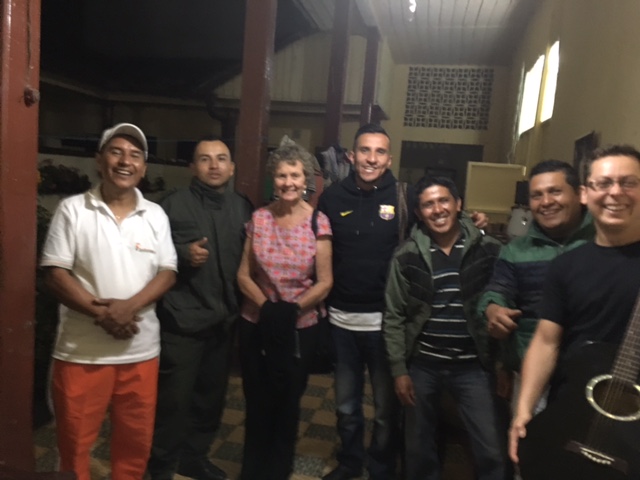 tes: “Colombia is an amazing country. The diverse landscape varies from soaring Andean summits, beautiful Caribbean coastlines, cryptic archeological ruins and cobbled colonial towns. The people are so happy, friendly and helpful. We have enjoyed our holiday here so much. We started in Bogota, where we were looked after by Carlos’s brothers. A highlight was a wonderful recital of Andean music organised for us by Manuel, a friend of Carlos’s brother. This was a most memorable evening.”
Ten years ago last night I attended my first rehearsal of the Manly Warringah Choir. How do I remember the day? After emigrating from England and three months being of no fixed abode, this was the day we finally moved into our house in Allambie Heights. At 7pm I left Anne re-discovering our lives as she unpacked newly delivered crates and boxes, and was shepherded by John Tesseyman, whom I had met at the local church, to MWC rehearsal. We were rehearsing the Bach Christmas Oratorio, which by coincidence was the work I would have been singing in the UK with my old choir, on the same day, had we not come to Australia.
What a lot has happened over those ten years! Under Carlos’ direction, the Choir has grown steadily in both numbers and capability. There have been many musical highlights. For me the standouts have been two performances each of the Brahms German Requiem and the Mozart Requiem, and the stunning performance of Bach’s St John Passion earlier this year. But that is not to say that all the other concerts have been lesser in some way – Messiah, Faure’s Requiem, Schubert masses, the Gounod Mass, the Armed Man, Rutter’s Requiem and many more performances have made me very proud to be a member of MWC.
What makes MWC special? Firstly, it is the way in which Carlos, ably abetted by Angela, blends the skills of musicians of such a wide range of experience and ability to produce concerts of a very high standard. It has been said that our singing belies our amateur status. That is indeed a compliment to us all, but above all to Carlos. He is where the buck stops.
Secondly, in a world which seems to be becoming increasingly polarized and bellicose, it is great to be a part of an activity which can only succeed by co-operation and mutual support.
Thirdly, the friendships engendered by working with other Choir members towards a common goal have done much to ease the disruption of relocating late in life.
How to celebrate these ten years? I am ashamed to say that last night I got caught out by several of those unexpected changes of key, rhythm or mood that characterise Stella Natalis, and which I have banged on about several times in this column. So it will be penance rather than celebration as I spend time on the score this week, marking up the change points in the score and running through each transition several times to imprint it on my brain.
Here’s to the next ten years, whatever they might hold!
No, not bass as in the bottom line of choral singing, but Bass as in the strait which separates Tasmania from Australia, or, as Tasmanians would say, the strait which separates Australia from Tasmania. Anne and I have just spent a couple of weeks there on holiday. It’s a beautiful place populated by warm, friendly people. And the idea of a holiday is that you leave all your everyday cares and concerns behind.
Which we did, in the main. The scenery is stunning, quite different from anything on the mainland. My favourites were the rich pastoral landscapes with a broad backdrop of craggy mountains, snow-capped for good effect. There are places in the wilderness where, were it flat, the end of the world would be just over the horizon. The West Coast Wilderness Railway passes through some of the most inhospitable landscape ever tackled by civil engineers. And Hobart is a delightful place, with both grand and lowly original sandstone buildings, thoughtfully restored and still in use, peppered between more modern constructions.
So how about the connections? The first was at Sunday morning service at Hobart Cathedral, complete with choir. The psalm of the day was sung – “I will lift up mine eyes to the hills from whence cometh my help”. Of course, it was Psalm 121, which is the basis for The Protector in Stella Natalis. The music was not Karl Jenkins, but it was a chance to focus on the words and their profound meaning. So it was very interesting to sing the Jenkins version at rehearsal last night. Carlos was at his most lyrical, cajoling us into singing not just the notes, but even more so, the words. He asked us to look at the words of every piece before we sing them, to soak up their meaning, to enter into the spirit of both words and music, and to project those ideas to the audience. That is what makes for a good performance.
The second connection was a bit tenuous. It happened at the start of Holst’s Planets Suite, which the Tasmanian Symphony Orchestra played brilliantly in the perfect acoustic of the Federation Hall. Mars, the Bringer of War, started with a strange beat, and I thought, “I have been here recently”, but I could not make out what was making the connection. Then it came to me – not two, three, four or six beats to a bar, not even five, but SEVEN! Just like Wintertide in Stella Natalis! Holst uses the rhythm to create the jarring effect of conflict and weaponry. Jenkins uses the same device to create a scene of jagged icicles and involuntarily chattering teeth. Yet another point where we have to project the notes and the words to make for a good performance.
Oh yes, the third connection. This is the exception as it does involve a bass singer. Anne and I were very privileged to have been given tickets to hear a concert by The Tallis Scholars in Newcastle on Tuesday evening. Think Allegri Miserere and Spem in Alium, and more besides. It was superb. Also in the audience were Jack and Sandra Christie. They are settled in their new environment and have joined the Newcastle University Choir. It seems much more disciplined than MWC, for example there being absolutely no chatter during rehearsals. Sandra commented that she misses the cameraderie of the back row of the MWC altos!. They send their best wishes to us all.