It’s been a long time coming……..

Some things have to planned way in advance.  An overseas trip might be one example, an expedition to the outback another.  When you start the planning with, say, organising tickets or establishing a route, the event seems a long way off.  And it stays a long way off in your mind, through all the planning and preparation, right up to a day or so before the day of departure.  Then it suddenly rushes up at you, and it’s there.  It is time to set off.

A German Requiem has been a bit like that.  We have carefully rehearsed every movement several times over the course of fourteen long weeks.  Committee members have been preparing the logistics of publicity, tickets, venue, orchestra, soloists and a host of other details.  Until recently it has seemed that the concert itself was a long way off, almost over the horizon.

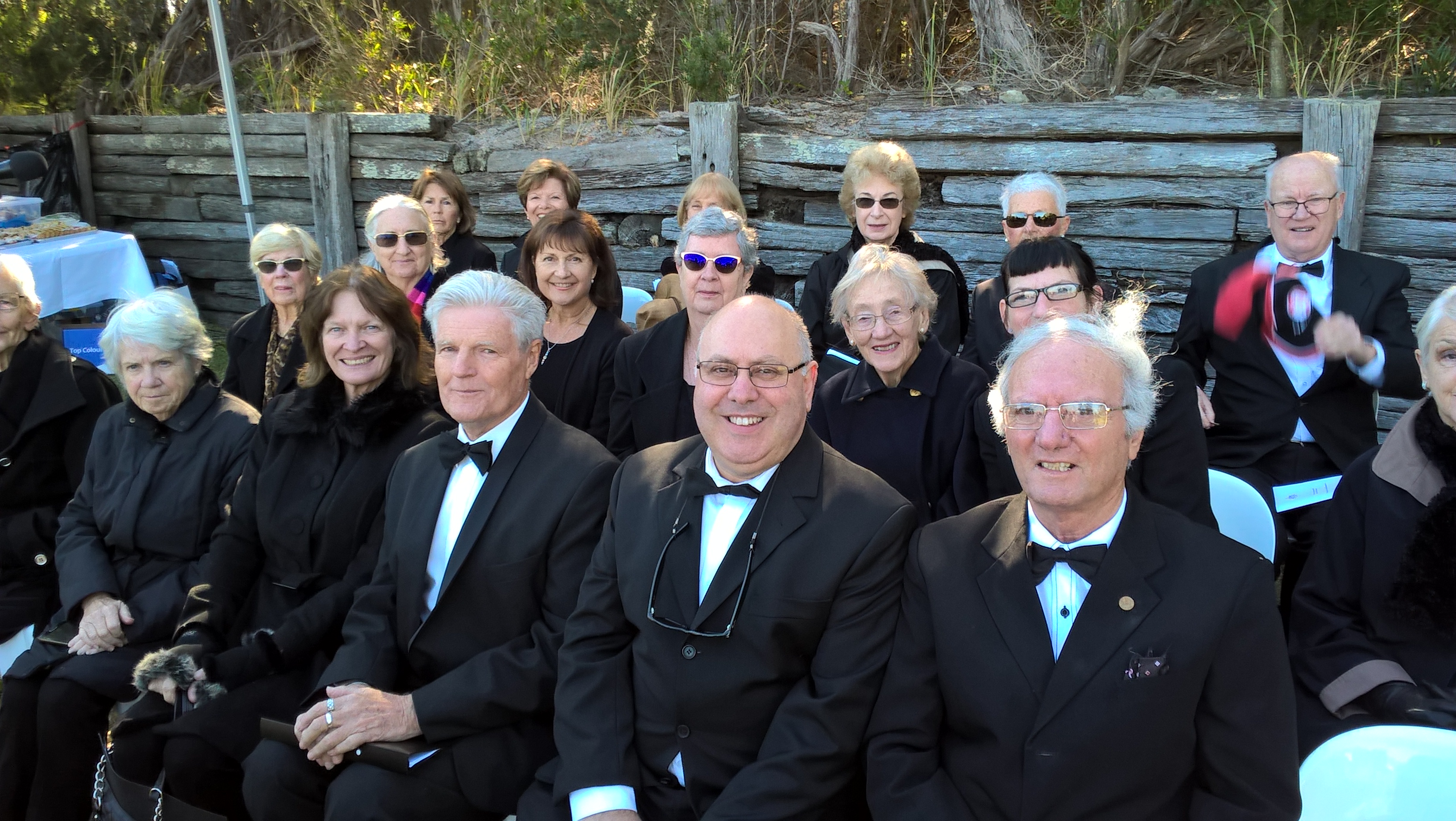
And then, yesterday evening, suddenly it all became real.  In the barn-like large hall at Collaroy Plateau Public School, we came together with the orchestra and soloists.  What a sound!  What fabulous music!

And then last night in the Cardinal Cerretti Chapel it all sounded even better.  We were confident, we did not fluff any notes (well, very few!), the orchestra sounded spot on, and the soloists were magnificent.  Carlos must have been well pleased as he did not ask us to repeat much and he let us off early – that does not happen often!

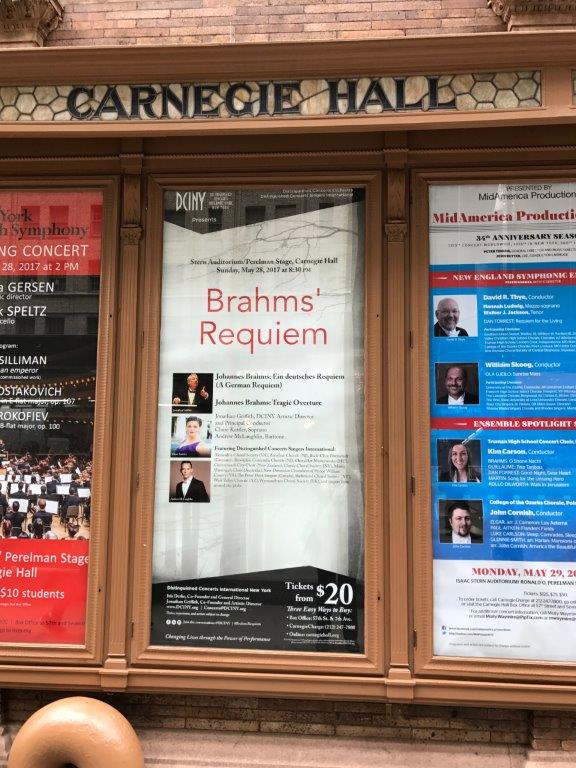
And the best bit?  We get to do it all again on Saturday, this time sharing our appreciation of this wonderful music with 300 people in the audience, who I am sure will derive just as much pleasure from our singing as we do ourselves.

Loud and soft, fast and slow

Wasn’t it another wonderful rehearsal last night!

Immersed in this incredible music, with Carlos directing us, Angela accompanying us and Anita soaring so beautifully over us, it seemed that the break was upon us almost before we had even started.  Yet in that time we had polished three of the movements to something of a gloss, focusing on all that the music contains – notes, words, and, above all, expression.

I arrived expecting to be on top of the music.  I had made space during the week to look through the whole work, ensuring that those dodgy intervals were secure, all the unexpected leads covered, and all the pronunciation correct.  What I should also have done, of course, was to check all the louds and softs, the lentos and allegros, the marcatos and legatos and, most of all, the crescendos and descescendos.

Singing to a given time or volume is pretty straightforward.  Singing loudly comes naturally to us all; singing softly not quite so naturally, but we can do it if we think about it in advance.  The tricky part is in changing volume, and especially in doing so gradually rather than snapping from one level to another instantaneously.  I find it helps to think about braking a car.  You have to assess current speed, desired speed and the distance you have to change, and apply the brakes to just the right extent.  Similarly, to change volume gradually, you have to think of current volume, intended volume, and how many notes or bars there are to get to the new volume – then you can make the change smoothly, just as you would when braking the car.

It is said that Alfred Brendel, the famous pianist, consciously developed twenty three distinct levels of volume in his playing.  Now that may be too many for us, but thinking of, say five levels, could help in judging how to get from p to f or from f to p over the space of one or two bars, as Brahms often asks us to do in A German Requiem.

In driving, you have to read the road ahead: in singing you have to read ahead in the music. In the Choir we have an extra aid which you do not have when driving.  Carlos  indicates with his hands, his body movements and his facial expressions what should happen and how we should be singing.

Watching Carlos is not an optional extra.  It is compulsory.  By all of us responding to him and by following the directions in the score, we will indeed thrill the audience with this wonderful music.


Sometimes I sits and thinks……

Do you remember the BBC’s Morecambe and Wise show where Andre Previn was the guest?  Eric Morecambe pretends to play the opening of the Greig piano concerto with Andre Previn conducting an orchestra.  Needless to say it is a shambles. When Morecambe is taken to task by Previn, he says aggressively that there cannot have been a problem because he was definitely playing all the right notes, but then adds sotto voce that they may not necessarily have been in the right order.

I was reminded of that last night for different reasons when we sang all through A German Requiem, but not in sequence.  I seem to remember that it went something like No 1, the fugue from 3, the fugue from 6, 2, 3 (complete), 4, 7, 5.  This made us focus more than usually on the words and the character of the music, as we had to stop and think at the commencement of each item where we were in the overall piece.

Other than that, there was not much time for reflection at last night’s rehearsal.  Carlos kept us all working hard throughout the evening, with only modest pauses when he focused on the tuning for one particular voice.

In such moments, I found myself wondering what we were all thinking as we sang this inspiring music to such a powerful text.  Carlos caught me unawares as he movingly translated the opening words of No 3 into English:  “Lord, let me know my end and the measure of my days; what it is, that I may know how frail I am.”   We all know people who are dealing with the imponderable nature of chronic illness.   We have all lost loved ones, Carlos himself most recently with the untimely death of his beloved soulmate Alexandra in December.

It is very fitting that this concert is dedicated to Alexandra’s memory. I am sure we will all rehearse that little bit more and concentrate that little bit harder in order to make it a performance worthy of someone who was both a consummate musician and an inspiration to us all, and who gave so much to MWC in so many ways.


Friday morning musings

It is Good Friday morning, and as I write the sublime sound of Bach’s St Matthew Passion pervades the house, a tradition for Anne and me of several years’ standing.  It is a recording made by the Bach Choir in 1979, conducted by Sir David Wilcox, and sung in English.  We used to hear the same ensemble perform this work in London on one of the two Sundays prior to Easter.  Sir David made each performance a very moving occasion.  The work was performed very reverentially but without compromising any the of drama inherent in the story.  He instructed that there should be no applause.  At the end of the performance audience and choir members alike were invited to remain in their seats, reflecting on what we had just heard or sung, and to leave when we felt ready.  It is amazing to think that this took place in the secular environment of the Royal Festival Hall, yet each performance verged on an act of worship in the truest sense.

There is something about the way Bach tells the story of the passion which is compelling.  This note will doubtless take much longer to write than usual as I pause every so often to listen more intently to some of the key passages.

In addition to listening to this recording of the St Matthew Passion today, we had the privilege last week of hearing the St John Passion sung by the choir of St James King Street, with the special treat of Richard Butler as the Evangelist. That brought back memories of this time last year, when we were in the final throes of preparing our own performance, which was indeed a triumph for a community choir such as MWC.

But back to this year.  Last night we managed a second full run through of Ein Deutsche Requiem, which was both exhilarating and tiring.  Who was the most exhausted at the end of the rehearsal?  Carlos, from watching and giving all the beats and entries, and communicating to us the ever-changing atmosphere of the music?  Angela, from playing the relentlessly fiendish piano reduction of a full orchestral score?  Choir members, from giving their all in concentration and the physical effort of singing?  I do not know the answer, and to some extent it does not matter. There was a wonderful sense of satisfaction at having sung the full piece, and in the realisation that, with some more hard work over the next few weeks, we are well positioned to give a very creditable performance on May 6th.

It has indeed taken longer than usual to compose today’s musings  It’s already the end of Part One of the St Matthew Passion.  Time now to make the coffee!


At the last trumpet

Over the past few weeks we have spent a lot of time on No 6 in A German Requiem, and last night’s rehearsal included a final polish of the piece.   I had noticed some familiar words in the English translation: Behold, I tell you a mystery.  Isn’t that from Handel’s Messiah?  I read on: We shall not all sleep but we shall be changed, in a moment, in the twinkling of an eye, at the last trumpet. Yes, checking in my score of Messiah, those are the words of the bass recitative introducing The trumpet shall sound.   This might be worthy of more investigation.

Handel wrote Messiah reputedly over the space of twenty-four days in 1742, and Brahms wrote A German Requiem over several years leading up to 1869.  There is only 120 years separating the composition of these two remarkable works.  But the treatment of the words in common between the two works is so different.

Handel sets the words above for bass soloist in pure recitative, whereas Brahms  involves the choir and orchestra, adding colour and a little drama.

Then there comes a big difference.  Handel sets The trumpet shall sound and the dead be raised incorruptible, and we shall be changed for the bass soloist and a wonderful trumpet accompaniment in the orchestra.  The duet between the two is clear and triumphal.  Brahms on the other hand sets the words for the full choir with a powerful orchestral accompaniment which is not only triumphal but also much more dramatic.  The music is not just beautiful – it demands to be listened to and taken notice of.

And then comes the biggest contrast.  O death, where is thy sting?  O grave, where is thy victory?  In Messiah, this is a charming duet for Alto and Tenor soloists, which is most often omitted in performance due to time pressures.  You cannot possibly omit this section in A German Requiem.  There is an added line of text: Death is swallowed up in victory.  The Choir is forceful, challenging death and the grave to prove their victory whilst knowing that they cannot do so. Last night, Carlos described the character of this music as angry:  I like to think of it as aggressively assertive to the point where no-one would dare to argue.

Two settings of the same words, 120 years apart.  Each setting is wonderful, but what a contrast between them!  And how fortunate we are to have them both to hear and to sing.