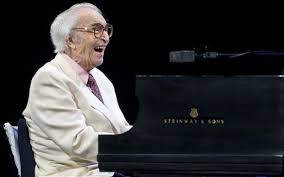
Take Five – then Seven

brubeckEven those of us with a only modest appreciation of jazz will remember Take Five, that gently swinging number by the Dave Brubeck Quartet.  Listening to it always gave me the feeling of standing in a crowded train swaying irregularly from side to side as it negotiated a particularly complicated junction or misaligned piece of track.  The effect is due to there being five beats in the bar instead of the usual two, three, four or six.  Sometimes a bar comprises three beats followed by two, sometimes two followed by three.

At M W Choir we don’t often get to sing music with five beats in a bar.  But last night I was reminded of Take Five as we rehearsed The Triangle Song in Stella Natalis.  Incidentally, I had expected, not unreasonably, I thought, a piece about a triangle to have three beats to a bar, but then Karl Jenkins is always doing the unexpected.

So how do you keep track of five beats in a bar?  Quirkily, perhaps, as per the instruction at the start of the music.  I found myself having great difficulty until I hit on the idea of tapping out on my knee “One, two, three, four, five”, repeatedly with the successive fingers (preceded by the thumb of course) of one hand.  By the end it was working quite nicely, and I hope that practicing during the week will reduce my reliance on the tapping to give more of the feel of the piece.

So – that’s a good technique for The Triangle Song.  But what about Wintertide?  That has the even more eclectic seven beats to the bar, and will need a different technique as most of us have only five fingers on one hand.  Does anyone have any ideas?  All suggestions are welcome!


It’s good to be back!

It was so good to get to Choir practice yesterday evening!  After three weeks away, it was indeed time to engage with Karl Jenkins’ Stella Natalis. 

I had flown to London and back, with loads of free time on the seemingly interminable journeys to do things like listen to music of my own choosing.  It just so happened that I had a recording of Stella Natalis, so that seemed an obvious choice.  I had not taken a copy of the score, as I figured that it would be good just to listen and to soak up the sound of the music.   And indeed it was intriguing.

Some of the harmonies are a bit predictable for a while, but then every so often a sequence which you think you understand morphs into a completely different key.

The rhythms are almost unfathomable.  Is that five beats to a bar? Or is it seven beats to a bar? And then it all changes to a standard three or four beats, just for a few bars, and then back to something less conventional.

It’s a very Northern Hemisphere work, painting a very realistic picture of a f.f.f.f.f.freezing  c.c.c.c.c.cold  c.c.cl.cl.cl.climate.

How on earth would all this look in the score?

So last night I was able to see on the page how Jenkins paints some of those marvellous soundscapes.   And, even better, we joined forces to create those soundscapes ourselves.  I was amazed at how far the Choir had progressed in just three weeks.  Yes, there is a lot more to do, but I felt that we had the measure of all of the first five movements, understanding the way in which the music works even if it needs more practice.

It’s going to be very exciting putting it all together.  I look forward eagerly to the next few weeks as the music takes shape under Carlos’ expert direction.

And now for something completely different

Last Thursday’s rehearsal was spent beginning to discover the delights of Karl Jenkins’ Stella Natalis, which we will perform at the Christmas concerts on December 3rd and 4th.  It was by all accounts a fun time, learning to s s s s sing and achieve other unusual vocal effects. It should not come as a surprise to those of us who have sung Jenkins’ The Armed Man and The Peacemakers.  Although these affects are unusual, they never dissolve into triteness as Jenkins always uses them skilfully and effectively.

Karl Jenkins’ next major work will be premiered this coming October in Wales.  It commemorates the Aberfan disaster of 1966, when a coal spoil heap collapsed, engulfing a school and surrounding buildings with horrific loss of life.  Click here to read more about Cantata Memoria.


Thank you

The Choir offers a huge “Thank you” to Margaret Jackson of Fairlight for writing to the Manly Daily to express her appreciation of last Sunday’s Afternoon at the Opera.  It’s great for us to receive such unsolicited public praise.

Thank you again, Margaret.


An Afternoon at the Opera

m_SAM_02672This afternoon’s concert proved something of a triumph in more ways than one.  For a start, the weather was perfect for the drinks and nibbles on the terrace afterwards.  Secondly, the soloists were terrific.  Thirdly, we in the Choir acquitted ourselves very well by singing most pieces better than we had ever sung them in rehearsal.

Best of all, it was quite clear from the audience’s response that we gave a lot of people a most enjoyable Sunday afternoon.  Musically the concert was up to our usual quality, if the applause was anything to go by.  And socially, that we were still clearing up over an hour after the end of the concert suggests that people were more than happy to linger over drinks in such a pleasant atmosphere.

For this correspondent, there were a number of highlights.  Joel Scott’s singing was amazingly fluent and varied in mood.  His voice has a lovely timbre, which he flexed to create moments of tenderness and others of passion.  Kathryn Williams brought the house to its feet at one point with a brilliant display of coloratura, yet also merged in with the Choir most effectively.   The Choir sang confidently throughout, with firm entries and clear cut-offs, following Carlos’ directions to give the music light and shade.  Singing through the Porgy and Bess Suite without stopping for not quite the first time was quite a bonus.

The afternoon had many stars.  Kathryn, Joel, the Choir, and of course Carlos, on whose shoulders rests the full responsibility of making the afternoon a success.  If there was to be a prize for the hardest working person, it would unquestionably go to Angela Ferguson, our accompanist.  We have become so used to her coping at rehearsals with anything she might be asked to play that we almost take her for granted.  But today was a performance, not a rehearsal, and she played a succession of very difficult and complex piano reductions of orchestral scores to a demanding performance standard.

It has been fun to sing these operatic excerpts.  They have been difficult to learn, especially the French and Italian words.  But, once learnt, they have almost sung themselves. Most importantly, the audience clearly felt that they formed an ideal program for a sunny winter’s afternoon.

Thank you to Mark Renton for the photo at the top of the page.  For some more photos, click here.